




What is the importance of patterns in mathematics?
 Jul 16, 2025|
 Patterns are an integral part of mathematics, playing a crucial role in various aspects of the discipline. As a pattern supplier, I have witnessed firsthand the significance of patterns in both theoretical and practical applications. In this blog post, I will delve into the importance of patterns in mathematics, exploring how they contribute to problem - solving, understanding mathematical concepts, and real - world applications.
Patterns in Problem - Solving
One of the most significant roles of patterns in mathematics is their use in problem - solving. Patterns allow mathematicians to identify regularities in data or a sequence of numbers, which can then be used to predict future values or find solutions to complex problems.
For instance, consider the Fibonacci sequence: 0, 1, 1, 2, 3, 5, 8, 13, 21, … Each number in the sequence is the sum of the two preceding ones. By recognizing this pattern, we can easily calculate subsequent numbers in the sequence without having to perform repeated addition. This simple yet powerful pattern has numerous applications in nature, art, and even financial markets.
In algebraic problem - solving, patterns can help us simplify equations and find solutions more efficiently. When we observe a pattern in a series of equations, we can often develop a general formula that can be applied to a wide range of similar problems. For example, in the study of arithmetic progressions (sequences where the difference between consecutive terms is constant), we can use the pattern to find the nth term of the sequence using the formula (a_n=a_1+(n - 1)d), where (a_1) is the first term, (d) is the common difference, and (n) is the term number.
Patterns also play a vital role in geometric problem - solving. Geometric patterns, such as the symmetry in shapes, can help us understand the properties of figures and solve problems related to area, perimeter, and volume. For example, the symmetry of a square allows us to divide it into smaller congruent parts, which simplifies the calculation of its area.
Understanding Mathematical Concepts
Patterns are essential for understanding fundamental mathematical concepts. They provide a visual and intuitive way to represent abstract ideas, making them more accessible to learners.
In number theory, patterns in prime numbers have fascinated mathematicians for centuries. Although prime numbers seem to appear randomly at first glance, there are still some underlying patterns. For example, all prime numbers greater than 3 can be written in the form (6k\pm1), where (k) is an integer. Recognizing these patterns helps us understand the distribution and properties of prime numbers better.

In calculus, patterns are used to understand the concepts of limits, derivatives, and integrals. The concept of a limit can be thought of as the pattern that a function approaches as the input values get closer and closer to a particular point. By observing the patterns in the values of a function as the input changes, we can determine its limit.
In probability theory, patterns in data can help us understand the likelihood of different events. For example, when rolling a fair six - sided die, the probability of getting each number from 1 to 6 is (\frac{1}{6}). By repeating the experiment many times and observing the pattern of the outcomes, we can verify this theoretical probability.
Real - World Applications
Patterns in mathematics have a wide range of real - world applications. They are used in fields such as science, engineering, finance, and computer science.
In science, patterns are used to model natural phenomena. For example, in physics, the patterns in the motion of celestial bodies led to the discovery of the laws of gravity. In biology, the patterns in DNA sequences are used to study genetics and evolution.
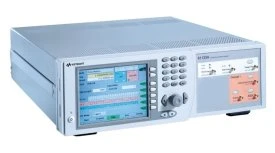
In engineering, patterns are used in the design and analysis of systems. Electrical engineers use patterns in electrical signals to design circuits and communication systems. For instance, 81133A Agilent Pulse Pattern Generator, 3.35 GHz is a device that can generate specific patterns of electrical pulses, which are crucial for testing and calibrating electronic components.
In finance, patterns are used to analyze market trends and make investment decisions. Technical analysts study patterns in stock prices, such as head - and - shoulders patterns or double - bottom patterns, to predict future price movements. By recognizing these patterns, investors can make more informed decisions about when to buy or sell stocks.
In computer science, patterns are used in algorithm design and programming. For example, the concept of recursion is based on the idea of a pattern where a problem is broken down into smaller, similar sub - problems. Many sorting algorithms, such as quicksort and mergesort, rely on patterns to efficiently sort large sets of data. Another example is the use of pattern matching in programming languages to search for specific patterns in text or data.
Our Role as a Pattern Supplier
As a pattern supplier, we play a crucial role in providing the tools and resources needed to work with patterns in mathematics and its applications. We offer a wide range of products, including the 8114A Agilent Pulse Generator, High Power, 100V, 2A and 81104A Agilent Pulse Generator,80 MHz, which are essential for generating and analyzing patterns in electrical signals.
Our products are designed to meet the needs of researchers, engineers, and students in various fields. Whether you are working on a complex mathematical model, designing a new electronic device, or teaching a class on patterns in mathematics, our pattern generators can provide you with the accurate and reliable patterns you need.
Conclusion
In conclusion, patterns are of utmost importance in mathematics. They are the key to problem - solving, understanding mathematical concepts, and applying mathematics to real - world situations. As a pattern supplier, we are committed to providing high - quality products that enable our customers to explore and utilize the power of patterns in their work.
If you are interested in learning more about our pattern - related products or have specific requirements for your projects, we encourage you to contact us for procurement and further discussions. We look forward to working with you to unlock the potential of patterns in mathematics and beyond.
References
- Devlin, K. (2000). The Math Gene: How Mathematical Thinking Evolved and Why Numbers Are Like Gossip. Basic Books.
- Livio, M. (2002). The Golden Ratio: The Story of Phi, the World's Most Astonishing Number. Broadway Books.
- Stewart, I. (1995). Nature's Numbers: The Unreal Reality of Mathematics. Basic Books.