Oscilloscopes

The Best Oscilloscopes Manufacture!
 

Established in 2016, PH Tool and Test Equipment Inc, We rent electronic test and measurement equipment. We also sell test equipment. We also have an in-house repair lab or offer a trade-in program.


Why Choose Us

Our Services

Whether you need to rent and buy test equipment, repair test equipment, sell or trade equipment, we are committed to providing excellent customer service and high-quality electronic test equipment.

Solutions

We provide customers with a variety of practical, efficient and affordable solutions to meet the test equipment needs of their business or project.

Competitive Pricing

We carry a comprehensive inventory of equipment and can use our extensive network to find those hard-to-get items for you. We believe in providing you with equipment quickly and at a competitive price.

First 12 Last 1/2
Oscilloscope Specifications


Sensitivity

It means the vertical sensitivity. It refers to the smallest deflection factor 1/S = G and is expressed as mV/div. The attenuator of the vertical amplifier is calibrated in mV/div. The divisions are read on a graticule fixed to the tube face.


Bandwidth

Bandwidth is the range of frequencies between ±3 dB of centre frequency. The vertical amplifier is fed from 0 V DC to that frequency at which the output falls to 3 dB. Low frequency oscilloscopes are up to 10 MHz and high frequency up to 350 MHz.


Rise time

In order to increase the utility of oscilloscope for pulse measurements, the rise time is also specified. Rise time is the time taken by the pulse to rise from 10 to 90% of its amplitude.


Types of Oscilloscopes


Type

Bandwidth

Sample Rate

Portability

Typical Use Cases

Analog

Low to Moderate

N/A (Analog)

Bulky, less portable

Education, basic troubleshooting

DSO

Moderate to High

High

Moderate

Advanced diagnostics, research

MSO

Moderate to High

High

Moderate

Mixed-signal applications, development

Handheld

Low to Moderate

Moderate

Highly portable

Field diagnostics, on-the-go measurements


What are the Components of an Oscillosco

Display Screen: Shows the waveform of the signal being measured.
 

Vertical Controls: Adjust the voltage scale and offset of the signal.
 

Horizontal Controls: Control the time base or sweep speed of the signal, determining how the waveform is displayed over time.
 

Trigger Controls: Help stabilize the waveform display by setting a specific voltage level at which the oscilloscope starts to record.
 

Input Channels: Allow the oscilloscope to measure signals from different sources simultaneously.
 

Multifunction Buttons: Provide quick access to frequently used features and settings, allowing for efficient adjustments and navigation within the oscilloscope's interface.

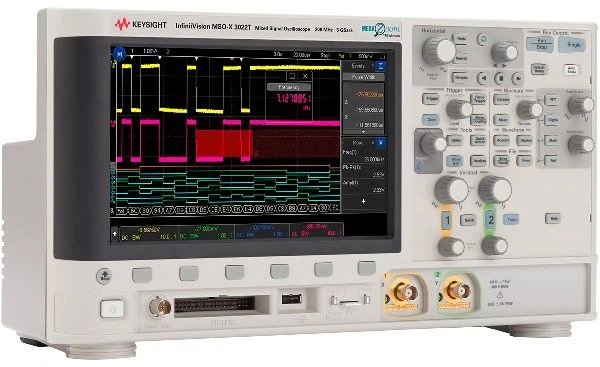
MSOX3022T Keysight Mixed Signal Oscilloscope: 200 MHz, 2 Analog Plus 16 Digital Channels


What is an oscilloscope used for
1

Waveform visualization: The oscilloscope can visually display electrical waveforms, and users can analyze data in real time, including signal shape, amplitude, frequency and timing characteristics.

2

Signal measurement: The oscilloscope provides precise measurements including voltage, current, frequency, period, rise time, fall time and other waveform parameters. These measurements help analyze electronic circuits.

3

Troubleshooting and debugging: Oscilloscope is a valuable tool for troubleshooting circuit faults. By observing waveforms at different points in the circuit, engineers can identify and locate problems such as signal distortion, noise, glitches, timing issues, and voltage anomalies.

4

Signal integrity analysis: In high-speed digital systems, maintaining signal integrity is crucial. Oscilloscopes are helpful in analyzing signal quality, measuring signal distortion, verifying signal levels, and evaluating the performance of data transmissions and clock signals.

5

Time-domain analysis: Oscilloscopes provide a time-domain view of signals, enabling engineers to study transient events, timing relationships, and synchronization issues. This is especially useful for analyzing pulsed signals, modulation and time-varying phenomena.

6

Frequency domain analysis: With additional tools such as Fast Fourier Transform (FFT), the oscilloscope can analyze signals in the frequency domain. This enables the user to determine the frequency content, harmonics, distortion and spectral characteristics of the signal.

7

Signal characterization and verification: Oscilloscopes help verify the design and performance of electronic circuits. Engineers can compare actual waveforms to expected waveforms, verify circuit behavior, and verify compliance with codes and standards.

8

Research and development: Oscilloscopes play a vital role in research and development activities. They are used to analyze and evaluate new technologies, test prototypes, measure system performance, and study the behavior of complex electronic systems.

9

Education and training: Educational institutions often use oscilloscopes to teach electronics principles, signal analysis, and circuit troubleshooting. They enable students to visualize and understand the behavior of electrical signals.


To order through the online ordering system, The following steps have to be taken
Add items to the shopping cart.
This can be done on the product pages of each product, by clicking the shopping cart symbol. The contents of the shopping cart will be shown in the upper right corner of the screen. The amount of items in the shopping cart can be changed on the details page.
Checkout.
This will show a form that has to be filled with the indicated information. Please make sure to enter a valid email address as this will be used to contact you.
Send order.
This will send the order to the sales department and a copy to the email address that was provided. The sales department will then send a invoice by email including shipping cost and payment methods.
Payment.
Payment can be done in the ways indicated on the invoice. International orders require payment in advance. When the payment has arrived, will ship the product(s).


FAQ

Q: What is the feature of oscilloscope?

A: Oscilloscopes (or scopes) test and display voltage signals as waveforms, visual representations of the variation of voltage over time. The signals are plotted on a graph, which shows how the signal changes. The vertical (Y) access represents the voltage measurement and the horizontal (X) axis represents time.

Q: What is 1X and 10x in oscilloscope?

A: 1x probes are good for small signals, but have limited bandwidth. 10x probes are good for larger signals, have wider bandwidth, and load the circuit less than 1x probes. When using a probe that attenuates the input signal, it´s important to use the correct scope settings.

Q: What is a general-purpose oscilloscope?

A: A general-purpose oscilloscope is a versatile instrument designed for a wide range of applications. It typically offers basic features suitable for most routine measurements and troubleshooting tasks in electronics and electrical engineering.

Q: Are oscilloscopes still used?

A: Yes, oscilloscopes are still widely used in various fields, including electronics, electrical engineering, and telecommunications. They remain essential tools for analyzing and troubleshooting electrical signals.

Q: Why are oscilloscopes so expensive?

A: Oscilloscopes can be expensive due to their complex technology, high-performance capabilities, and advanced features. Factors such as bandwidth, sample rate, memory depth, and additional functionalities contribute to their cost.

Q: What not to do with an oscilloscope?

A: Avoid using an oscilloscope with damaged probes or cables, exposing it to extreme environmental conditions, or operating it with incorrect settings. Ensure proper calibration and maintenance to prevent inaccurate measurements and potential damage.

Q: Are cheap oscilloscopes worth it?

A: Cheap oscilloscopes can be worth it for basic measurements and educational purposes. However, they may lack advanced features, accuracy, and reliability found in higher-end models. Evaluate your needs and consider investing in a quality oscilloscope for critical applications.

Q: What does an oscilloscope help us to see?

A: An oscilloscope helps us to see the waveform of electrical signals, including their amplitude, frequency, and shape. It allows for detailed analysis of how signals vary over time, aiding in troubleshooting, design verification, and signal characterization.

Q: What is the minimum order quantity for oscilloscope?

A: The minimum order quantity is mentioned with the product and varies from company to company.

Q: What types of payment methods are accepted by the oscilloscope suppliers?

A: It depends on the specific oscilloscope supplier. Some common payment methods accepted by suppliers include cash, bank transfer, credit card, e-wallet, online payment systems etc.

Q: Is oscilloscope AC or DC?

A: Oscilloscopes are designed to have a flat, consistent frequency response over the full bandwidth range. A little bit of offset or scaling might be required, but they can easily measure AC signals while in DC coupling mode. That's what they're made for.

Q: What are the 3 main control sections of an oscilloscope?

A: A basic oscope consists of three different systems – the vertical system, horizontal system, and trigger system. Each system contributes to the oscilloscope's ability to accurately reconstruct a signal. The front panel of an oscilloscope is divided into three sections labeled Vertical, Horizontal, and Trigger.

Q: Is oscilloscope analog or digital?

A: Oscilloscopes can be classified similarly – as analog and digital types. In contrast to an analog oscilloscope, a digital oscilloscope uses an analog-to-digital converter (ADC) to convert the measured voltage into digital information.

Q: What is the 5 times rule for oscilloscope?

A: As a rule of thumb, your oscilloscope's bandwidth should be at least five times higher than the fastest digital clock rate in your system under test. If your oscilloscope meets this criterion, it will capture up to the fifth harmonic of your signal with minimum signal attenuation.

Q: What is the XY mode of oscilloscope?

A: Hidden in its functionality is an important feature known as XY mode. This often overlooked mode of operation essentially transforms your oscilloscope into a vector monitor. This will unlock a wealth of diagnostic and visual insights about your signals, especially those related to phase relationships.

Q: Is oscilloscope a logic analyzer?

A: An oscilloscope allows you to view analog voltages and how they change over time. Oscilloscopes are best used for evaluating signal integrity and measuring analog circuit performance.Logic analyzers represent signals in their digital form: a logic 0 or logic 1.

As one of the leading oscilloscopes manufacturers and suppliers in China, we warmly welcome you to buy high-grade oscilloscopes in stock here from our factory. All our products are with high quality and competitive price. For more information, contact us now.

MSO73304DX Tektronix Mixed Signal Oscilloscope 33 GHz 4 16 Ch 100 GS s, Oscilloscopes

(0/10)

clearall