

 Language

 Language
Quality service
We offer our customers several practical, efficient and cost effective solutions for their business or projects' test equipment needs.
Well appointed
We stock a comprehensive inventory of equipment and can use our extensive network to find you those hard to get items.
Rich experience
We have more than years of industry experience and a team of experienced engineers and technicians to ensure consistent precision and high quality of our products.
Professional team
The company is in possession of numbers of senior engineers and has abundant technique power, well conditioned equipment and technology comes to perfection.
Time-Saving Automation
Pulse generators can store and automate test sequences for repetitive tasks, eliminating the need for manual reconfiguration, which is especially useful for long-term or iterative testing.
Increased Accuracy
Automated settings minimize human error, ensuring consistent results across multiple tests.
Multichannel Support
They allow testing of multiple circuits simultaneously, significantly speeding up workflows for systems requiring parallel signal generation.
Control of Pulse Parameters
Pulse generators are designed to generate pulses and control pulse-related parameters like pulse width, rise/fall time, etc., unlike function generators which are not dedicated to this purpose.
Telecommunications: Pulse generators are crucial in testing and developing telecommunication systems. They help in simulating the digital signals used in these systems for testing purposes.
Medicine: In the medical field, pulse generators are used in various therapeutic and diagnostic applications. For instance, they are used in pacemakers to generate electrical pulses that help control heart rhythms.

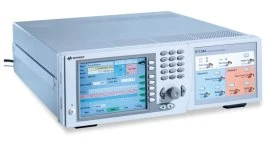
Research & Development: Pulse generators are used in labs for various experiments that require controlled electrical pulses. They’re also utilized in testing electronic systems and studying their responses to specific signal inputs.
Industrial Electronics: In industrial setups, pulse generators are used in various control systems and automation processes.
Types of Pulse Generators
Free-running Pulse Generators
These are the simplest type of pulse generators that continuously generate a train of pulses without any external input. The pulse repetition frequency is determined by the internal circuitry of the generator.
Synchronized Pulse Generators
Unlike free-running pulse generators, these devices produce pulses in sync with an external signal. They are used when precise timing is required, such as in radar systems or time-domain reflectometry.
Delayed Pulse Generators
These generators produce a pulse after a specific delay from an external trigger signal. This delay can be adjusted according to the needs of the application.
Keep the Device Clean
Dust and debris can accumulate on the surface and inside the device, potentially damaging sensitive components.Use a soft, lint-free cloth to wipe the exterior. For vents and hard-to-reach areas, use compressed air to remove dust.
Frequency: Clean the device every few weeks or as needed, depending on your environment.
Check for Firmware Updates
Firmware updates often include bug fixes, performance improvements, and compatibility upgrades.Visit the manufacturer’s website to download the latest firmware. Follow the provided instructions for a safe installation process.
Frequency: Check for updates every 3-6 months or whenever you encounter performance issues.
Inspect Connections Regularly
Loose or damaged cables can result in inconsistent signals and compromised test results.Regularly inspect all connectors and cables for wear, corrosion, or looseness. Replace damaged components promptly.
Tip: Use high-quality cables and connectors to minimize signal degradation.
Schedule Regular Calibration
Calibration ensures your pulse generator continues to provide accurate signals over time.Work with a certified calibration company to verify and adjust the device's performance.
Frequency: Schedule calibration annually or per the manufacturer’s recommendation.
As one of the leading pattern manufacturers and suppliers in China, we warmly welcome you to buy high-grade pattern in stock here from our factory. All our products are with high quality and competitive price. For more information, contact us now.
Pattern(0/10)
