

 Language

 Language
Our factory
Established in 2016, PH Tool and Test Equipment Inc strives to continually improve itself and offer the best value for its customers.
Business scope
We offer our customers several practical, efficient and cost effective solutions for their business or projects' test equipment needs. Whether you need to rent & buy test equipment, repair test equipment, sell or trade equipment, we are committed to providing superior customer service and high quality electronic test equipment. We provide several services. We rent electronic test and measurement equipment. We also sell test equipment. If you have a piece of malfunctioning or broken test equipment we also have an in-house repair lab. For anyone seeking a way to offload their surplus or obsolete equipment, we offer a trade-in program or we can buy the equipment from you.
Comprehensive inventory
We stock a comprehensive inventory of equipment and can use our extensive network to find you those hard to get items. We believe in getting equipment to you quickly and at a competitive price.
Our service
We try and respond to all concerns within 24 hours and our teams are always at your disposal in case of any emergencies.
Modular LAs
Modular LAs, which consist of both a chassis or mainframe and logic analyzer modules. The mainframe/chassis contains the display, controls, control computer, and multiple slots into which the actual data-capturing hardware is installed. The modules each have a specific number of channels, and multiple modules may be combined to obtain a very high channel count. While modular logic analyzers are typically more expensive, the ability to combine multiple modules to obtain a high channel count and the generally higher performance of modular logic analyzers often justifies the price. For the very high end modular logic analyzers, the user often must provide their own host PC or purchase an embedded controller compatible with the system.
Portable LAs
Portable LAs, sometimes referred to as standalone LAs. Portable logic analyzers integrate everything into a single package, with options installed at the factory. While portable logic analyzers generally have lower performance than their modular counterparts, they are often used for general purpose debugging by cost conscious users.
PC-based LAs
The hardware connects to a computer through a USB or Ethernet connection and relays the captured signals to the software on the computer. These devices are typically much smaller and less expensive because they make use of a PC's existing keyboard, display and CPU.
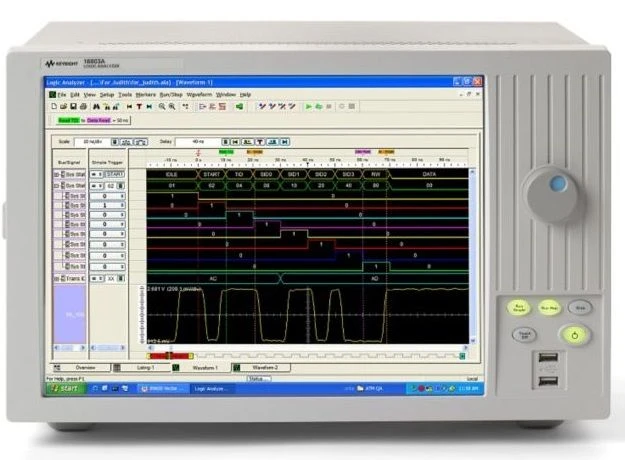
Debugging digital circuits
By capturing and analyzing digital signals, logic analyzers play a vital role in identifying and troubleshooting issues within digital circuits. They enable the detection of problems and facilitate their resolution through comprehensive analysis of the captured signals.
Protocol analysis
Logic analyzers can be used to decode and display different communication protocols, such as I2C, UART, SPI, and USB.
Embedded systems development
Logic analyzers can be used to debug and test firmware and software on embedded systems, such as microcontrollers and FPGAs.
Verification of digjital designs
Logic analyzers can be used to verify that a digital design is functioning as expected by capturing and analyzing the digital signals in the circuit.
Power analysis
Logic analyzers can also be used to monitor the power consumption of a digital circuit and identify power-related issues.
Security testing
Logic analyzers can be used to identify vulnerabilities in digital systems by capturing and analyzing the digital signals on a circuit.
Automotive testing
Logic analyzers have the capability to diagnose and validate different automotive systems, including engine control, transmission control, anti-lock braking systems, and other electronic control units. They serve as valuable tools for troubleshooting and testing these systems, ensuring their optimal performance and functionality.
Medical equipment testing
Logic analyzers can be used to test and debug digital systems in medical equipment such as patient monitors, imaging equipment and other diagnostic equipment.
What Makes a Logic Analyzer Unique?
Recording several input channels
A significant advantage of a logic analyzer is its ability to record a large number of digital signals simultaneously, usually 8 to 100 channels. While oscilloscopes can also record digital data, they typically cannot match the number of channels and recording duration as a logic analyzer due to the memory requirements of storing analog data.
Complex digital triggering
Similar to oscilloscopes, logic analyzers can be configured to begin recording on a trigger event. Triggers can be as simple as a single rising or falling edge of a particular channel, or they can be a complicated set of conditions that include edges or states of multiple channels.
Mixed-signal capability
Many modern logic analyzers include some oscilloscope functionality and vice versa. These new tools, capable of recording and analyzing digital as well as analog waveforms, are known as mixed-signal oscilloscopes. Test equipment that serve multiple purposes can make characterizing complex circuits and systems easier.
Portability
Many standalone logic analyzers include screens capable of displaying the captured signal data. However, as personal computers become more powerful with faster peripheral ports (for example, usb 3.0), some logic analyzers forgo the screen and rely on computer software to perform the analysis. This saves on equipment size and costs.
Ease of data navigation
Most logic analyzers work by capturing digital data, storing it in a buffer, and then displaying it on a screen. Some are capable of showing signals in real-time, much like an oscilloscope. While this can be useful to look for trends while a system is running, it can be difficult to search through and look for details in the signals. Logic analyzers, whether standalone or attached to a computer, usually include software or controls for navigating through large amounts of signal data. This can include zooming, panning, searching, etc.
Quick digital measurements
Modern logic analyzers and logic analyzer software contain many advanced features that help users characterize signals. This includes measuring aspects of the signal, such as pulse width, frequency and period of periodic signals, as well as duty cycle.
Decode and search transmitted data
Another unique feature of logic analyzers is the ability to decode signals. Most modern digital communication systems are implemented based on a set of protocols. Logic analyzers or their associated software can include these protocols, known as protocol analyzers, to help you make sense of the captured data. With recorded data, many logic analyzers will allow you to search through the data looking for particular patterns. In i2c for instance, we can look for the device's bus address, as that will denote the beginning of a transmission. Some logic analyzers will let you set a search pattern as the trigger condition to begin recording.
If you are in the market for buying or choosing a logic analyzer, how do you know which one is right for you? There are several options to select from and looking at the various technical specifications can be a daunting task. This article gives you some factors to consider when considering your purchase.
Channel count - The maximum number of digital channels supported by the logic analyzer. The more the channels the more debug capability. Typically a logic analyzer has around 8 channels. It’s always good for logic analyzers to have more channels based on the complexity of the embedded design.
Channel bandwidth - This can be defined by the maximum frequency that can be measured by the logic analyzer.
Sample rate - The logic analyzer needs to have the ability to capture glitches, setup, and hold time issues in the embedded design. Lowering the resolution of measurement by the logic analyzer, better the issues that can be captured in the design.
Voltage levels - The digital design comes with various logic levels. The logic analyzer needs to support logic families to debug the embedded system design. It’s always good to understand the voltage levels of the design and logic analyzer.
Trigger capability - A good logic analyzer can set complex and nested triggers. Understanding the trigger level and capability will help you select the right logic analyzer for you.
Probe type - The logic analyzer probes need to be easily connected to the design under test without creating any signal integrity issues.
Capture duration - During complex engineering debugging a very long capture sequence is required to do the analysis. Hence having a very large capture can be an added
Host interface - Usb 2.0 is the most commonly used interface for the logic analyzer some of them also have interfaces to the network using gigabit ethernet.
Support - Once you have the logic analyzer in your hand and run into issues during debug you will need a good team to support the debug issues in hand. Every company offers various levels of support.
Shipping lead time - Once the logic analyzer is ordered the product needs to be shipped to the development location. Please check the lead times well in advance before ordering.
Year of development - It’s always good to pick up a product that is stable in the market and used by many customers already.
Ease of use - Most of the logic analyzers are used to debug hard engineering problems and ease of use and integration.
As one of the leading logic manufacturers and suppliers in China, we warmly welcome you to buy high-grade logic in stock here from our factory. All our products are with high quality and competitive price. For more information, contact us now.
Logic(0/10)
